Individual learning is an important aspect of our antiracist and intersectional efforts for EDI and Accessibility, but individual prejudice is not a necessary ingredient of institutional racism. Institutional bias can happen regardless of how conscious individual participants are in how we engage with each other.
Individual actions may resolve individual cases of disequity, but to fix disequity at an institutional level, then we need to be able to responsively change institutional policy, procedures, and budgets. We identify disequity by evidence in data and expressions of lived experience. If we can measure a disequity, or people are telling us that they are experiencing one, we know it’s there.
We have done a lot of work finding and explicitly articulating our organizational “objectives”, “commitments”, “values”, but we also need to explicitly agree upon our collective approach to change, our methods of change. Without a consensus on “how” we change, every individual attempt at creating a change is an individual struggle.
If an individual or group with the right idea is in the right position, or suggests it to the right person at the right time, then we may have a successful institutional change. But this seems like we are missing a lot of opportunities. What if the feedback is coming from a student? A faculty member, a community member? Or a vendor?
My personal hope is that the antiracist audit is a step in the process of developing effective mechanisms of organizational change. I believe we want to do the right things, but we don't always know how to effectively change the organization to accomplish our goals. The audit will tell us some of **what** we need to change, but may not tell us **how**.
there may be some work for everyone...
main advantage to being on the team is participation in the design phase
outcomes:
use in the director hiring
baseline
change management suggestions from widerstand
is
surfacing suggestions and idesa during the
staff initiative
time in reporting and communication on EDI
Work shifted to be more embedded in job description
annual review small working group (what's going on )
QUT
[[OKR]]
older notes:
2020-08-27
Anti-racism, Diversity, Equity, & Inclusion Organizational Change Toolkit
DEI is not just raising empathic awareness which is necessary but not sufficient. it is ALSO organizational implementation of measurable improvements to access, engagement, and environment for constituents.
"cultivating connections over calculating demographics" -[Nicole Roach](https://www.higheredtoday.org/2018/01/08/stop-counting-start-courting-role-chief-diversity-officer/) to do this, we need actual information from the individuals affected
### Build assessment framework
#### Proposed:
- data gathering
- collection of respondents
- representatives of student, student workers, staff, faculty
- representatives of race, gender identity/orientation, dis(ability), neurodiversity, religion, home language, socioeconomic status, immigrant status, age, caregiver status, family education attainment
- paid quarterly qualitative and quantitative interviews/focus groups/interviews
- Policy Analysis
- Curricular development
- equity literacy principles (Gorski, P., & Swalwell, K. (2015). Equity literacy for all. Educational Leadership, 72(6), 34–40.)
- Direct Confrontation
Principles:
- Redistribution Principle
- Prioritization Principle
- Equity Ideology Principle
- #FixInjusticeNotKids
Principles:
- DEI Efforts through Objectives and Key Results lens:
- Categories
- Policing and safety
- Anti-Racist Information Literacy and Digital Scholarship
- Critical Operations Reform
- Staff Development and Training
- Community Programming
- Communication and Accountability
- Leadership Team Commitments
- where are the inequities?
- Outreach and Access
- Communication
- Programming
- Transparency
- Technology
- Staff and Culture
- Hiring and Retention
- Development and Training
- Representative Presentation
- Policies and Enforcement
- Operations
- Safety
- Learning Outcomes
- Collection Development
- Scholarship
- Information literacy efforts
- Supply Chain and Environment
- transportation
- facilities
- supplies procurement
- equipment purchasing
-
- https://libguides.usc.edu/diversityandinclusion/bestpractices
- https://studentaffairs.wsu.edu/media/256914/committingtoequityinclusiveexcellence.pdf
- Bring students as well as faculty and staff into the dialogue regarding institutional change.
- Identify where investments in equity and inclusion are already being made, and connect new efforts with those that are already established.
- identify accountability areas for progress
- outreach and access
- completion and transfer
- engaged or high-impact learning
- demonstrated achievement
- goal systems (top down vs. bottom up)
- "hard goals drive performance more effectively than easy goals, __specific__ hard goals produce a higher level of output than vaguely worded ones." -edwin locke qtd __Measure What Matters__
- Management by Objective: "annual, retrospective, backward-looking, top down, hierarchical and not very effective" -
- OKR: objectives and key results John Doerr https://www.youtube.com/watch?v=HiQ3Ofcmo50
- few things trying to highlight and isolate deserving special attention
- objectives are goalposts "significant, concrete, action oriented, and (ideally) inspirational
- key results are markers of progress (not a key result unless it has a number)
- also CFR (conversation feedback and recognition)
- benefits
- focused
- transparency = Alignment
- commitment
- track progress
- stretching ()build a risk taking culture)
- set higher goals (10x)
- "institutional no" conservatism vs safe to fail
- aspirational goals vs committed goals (100% success required)
- gates "too many nonprofits confuse their missions with their objectives"
- starting with transparency about what we find that we are not doing well, disclosing that and soliciting feedback to identify solutions and create the necessary pressure to adjust policies.
- Identifying inequity in current policy and procedures, through taking seriously the feedback from students/staff/faculty/community
- Publish the problem. Collect data about current outcomes demonstrating the problem
- Creating a plan to remedy the issues with representational input
- Implementing the plan
- Measuring new outcomes to evaluate success of the plan
- for example:
- Accept student feedback that fines are being unfairly applied, and disproportionately affect English Language Learners because of confusion about due dates and relative difficulty writing a narrative appeal.
- Collect and publish data about the fine appeal process (number of appeals, percentage successful, send questionnaire to students who have or have not filed appeals)
- Create a new plan with student, librarian, and administrative input: e.g. every student's first fine will be waived without the need for an appeal.
- Applying pressure/writing procedures as necessary to get new plan implemented
- after one year, repeating the data collection from step 1 to see if problem has improved. check with represented community to determine perceived outcomes (repeat 3-5 as necessary)
- like https://www.kingcounty.gov/elected/executive/equity-social-justice/tools-resources.aspx
- [Tools and Resources - King County](https://www.kingcounty.gov/elected/executive/equity-social-justice/tools-resources.aspx)
- The Equity Team has developed a variety of tools and resources to help departments and agencies increase equity and social justice work, both in our community and within the services King County Government provides.
- [www.kingcounty.gov](http://www.kingcounty.gov/)
- here is the equity scorecard: https://cue.usc.edu/tools/the-equity-scorecard/
- https://cue.usc.edu/files/2016/01/Introduction-to-the-EqS.pdf
- steps
- the identification of racial and ethnic gaps in educational outcomes,
- inquiry into instructional and academic support practices,
- purposeful changes in practices and policies based on the results of systematic inquiry,
- evaluation of the implemented changes.
- The Scorecard approach is premised on the idea that to bring about change, and attain racial equity in educational outcomes, it is important to express on campus the ways in which it is not working well... The Equity Scorecard™ asks faculty and staff to focus on what they can change, and therefore leads to real, meaningful action.
- places the power to identify and make change in the
hands of... the faculty and staff – who work directly with students.
- https://living-future.org/just/
- past proposals:
- still waiting
- naloxone training
- de-escalation training
- very simple gender-neutral restroom conversion on third floor
- redacting identifying information on hiring search responses (names, addresses, etc)
- first fine waiver without appeal
- have happened
- site redesign with focus on useablility
- labels replaced
- new signs behind circ desk
- designated point of reference for student in crisis
- accessible employment Application PDF
-
- members of the committee are mainly librarians, who are clearly committed to the importance and ideals of DEI, but a coherent and sustainable strategy for organizational self-analysis and change does not seem to be emerging from their efforts.
- Thank You!
- Thank you for your work on the solidarity statement and the commitments.
- Thanks for letting me share for a few minutes.
- Personal Commitments
- individual growth
- interpersonal care
- community support
- organizational change
- structural justice
- Goal
- to discuss how patterns and tools of organizational change management might help us more effectively remedy institutional racism in the library
- Definitions
- **Anti-racist** - Identifying and taking conscious action against racist oppression in its various forms (and levels)
- **Diversity** - visible representation of human differences
- **Equity** - collaborative accommodation of human differences toward increased individual opportunity
- **Inclusion **- collaborative efforts to increased sense of belonging and value to the community
- Levels of racism
- Individual
- part of the process of individual identity development
- privilege, prejudice, xenophobia
- internalized oppression and Stereotype threat
- Interpersonal
- performed racism identified in behaviors such as
- Aversive racism
- Microaggressions
- Violence
- Institutional
- bias within an organization
- individual prejudice is not a necessary ingredient
- identified by outcomes
- Structural
- cumulative among institutions
- Intergenerational
- [[Anti-racism, Diversity, Equity, & Inclusion Organizational Change Toolkit]] Draft
- Each is a limiting factor for the other, and each is necessary but not sufficient.
- Access-to and effectiveness-of educational opportunities is limited by our environment of policies and procedures,
- As an educational organization, we need to equally address our:
- Educational mission
- Organizational practices
- 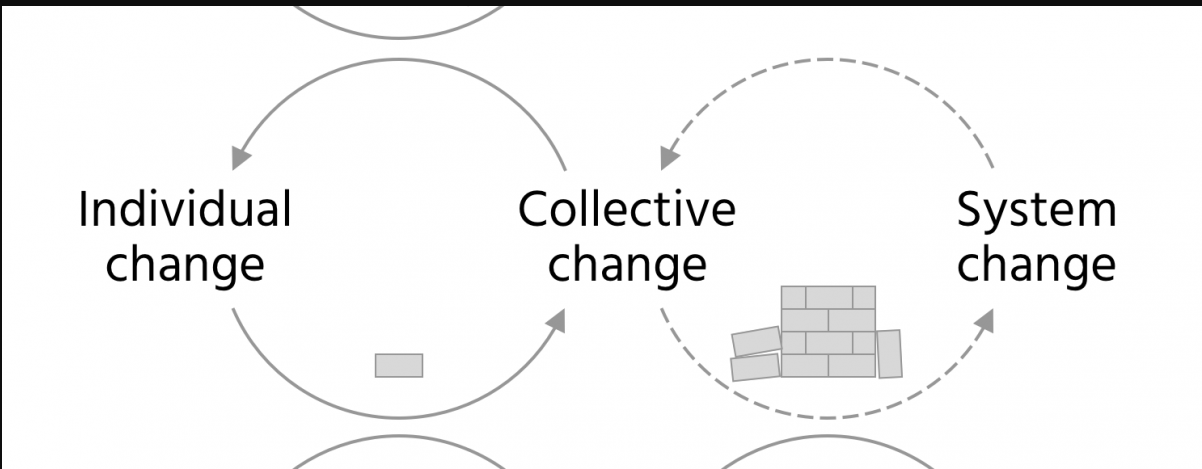
- https://www.jussipasanen.com/individual-change-or-system-change-is-not-the-right-question/
- 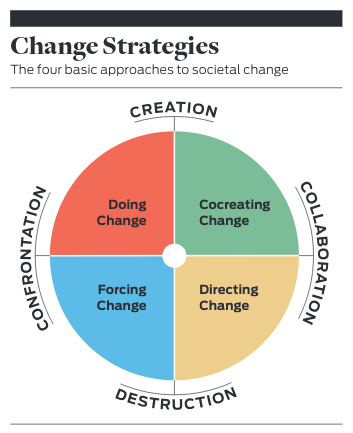
- http://humanisticmanagement.international/wp-content/uploads/2018/06/SSIR-FT_SocialTrans-2.pdf
- 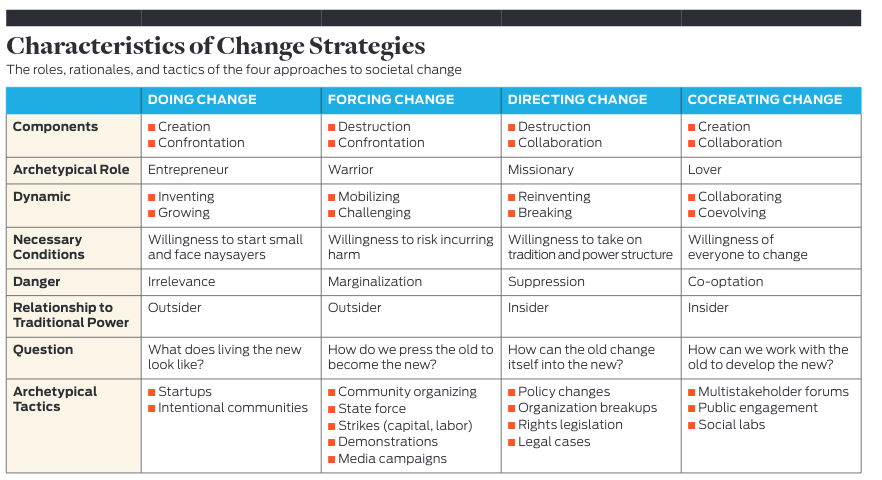
- http://humanisticmanagement.international/wp-content/uploads/2018/06/SSIR-FT_SocialTrans-2.pdf
- key property of complex systems is emergence, which is the tendency for systems to have properties that are distinct from those of their individual parts. Emergence is what makes systems so hard to predict, often leading to unintended consequences following an intervention.
- Addressing root causes
- Appreciating how problems and solutions have different levels and layers of complexity
- Accounting for relationships in causality of problems and solutions Shifting mindsets and behaviors
- Understanding and addressing power dynamics and interdependence
- Supporting improved policies and implementation of those policies
- Acknowledging that change is rarely linear
- Paying attention to emergence and unintended consequences
- https://www.rockpa.org/wp-content/uploads/2020/07/Rockefeller-Philanthropy-Advisors-Scaling-Solutions-Report.pdf
-
- UWB Library needs to adopt a framework for Anti-racism, Equity, Diversity, and Inclusion that supports and incentivizes organizational change.
- outline
- my background
- raised in the south
- neurodivergent identity
-
- definitions
- Equity
- Diversity
- Inclusion
- Anti-racism
- structural
- cumulative among institutions
- intergenerational
- institutional
- bias within an organization
- individual prejudice is not a necessary ingredient
- identified by outcomes
- interpersonal
- identified in behaviors
- Stereotype threat
- Aversive racism
- Microaggressions
- https://www.researchgate.net/publication/319321478_Aversive_Racism_Implicit_Bias_and_Microaggressions
- internalized
- individual identity development
- systems theory
- https://www.racialequitytools.org/resourcefiles/Powell_Systems_Thinking_Structural_Race_Overview.pdf
- system thinking
- communication
- power
- Identity Development
- [developmental paradigms ](https://www.wabash.edu/news/displaystory.cfm?news_ID=2614)
- Perry’s Scheme of Intellectual and Ethical Development
- Basseches’s Model of Dialectical Reasoning
- King’s Seven Stages of Reflective Judgment
- Brown’s Model of Wisdom Development [[
- experience coupled with cognitive development leads to more sophisticated approaches to construing and interpreting experience. Individual development, can be assessed by a variety of quantitative and qualitative assessment measures
- eg. Intercultural Development Inventory (IDI)
- 6 axes
- self-concept
- consistency
- control
- comfort
- commitment
- pathology
- 5 stages from Monocultural ... Intercultural
- Denial
- Polarization/defense/reversal
- Minimization
- Acceptance
- Adaptation
- SCARF model
- these five social domains activate the same **threat** and **reward** responses in our brain that we rely on for physical survival
- **Status** – our relative importance to others.
- **Certainty** – our ability to predict the future.
- **Autonomy** – our sense of control over events.
- **Relatedness** – how safe we feel with others.
- **Fairness** – how fair we perceive the exchanges between people to be.
- https://www.mindtools.com/pages/article/SCARF.htm
- implicit and explicit measures of bias
- performed racism
- intervention strategies
- individual
- institutional
- structural
- example: fines
- individual: borrower education
- institutional: changing fine structures at UW
- structural: re-imagining fines across ILL/Summit, reparations
- targeted universalism:
- a frame for designing policy that acknowledges our common goals, while also addressing the sharp contrasts in access to opportunity between differently situated sub-groups. Structurally transformative policies need to address these contrasts and measure success based on outcomes, rather than just intentions.
- dimensions of cultural difference
- Harris, Moran & Moran (2004)
- sense of self and space
- communication andl anguage
- dress and appearance
- food and feeding habits
- time and time consciousness
- relationships
- values and norms
- beliefs and attitudes
- learning
- work habits and practices.
- representational
- race,
- gender identity/orientation,
- dis(ability),
- neurodiversity,
- culture and religion,
- home language,
- socioeconomic status,
- immigrant status,
- caregiver status,
- age,
- family education attainment
- Organizational constituents
- Students
- Campus Staff and Faculty
- Library Staff and Faculty
- Broader Campus Community
- domains where DE&I apply
- Outreach and Access
- Communication
- Programming
- Transparency
- Technology
- Staff and Culture
- Hiring and Retention
- Development and Training
- Representative Presentation
- Policies and Enforcement
- Operations
- Safety
- Learning Outcomes
- Collection Development
- Scholarship
- Information literacy efforts
- Supply Chain and Environment
- transportation
- facilities
- supplies procurement
- equipment purchasing
- current practices
- missing pieces
- culture of acknowledging and accepting risk
- finding feedback channels
- Bring students as well as faculty and staff into the dialogue regarding institutional change.
- constituent interviews
- representational
- transparency and accountability
- identify accountability areas for progress
- centralized
- goal setting (measurable goals)
- bottom up
- top down
- individual development
- ROTI Return on time invested
-
- **Organizational Change Management Techniques **
- **Kotter 8-Step Process for Leading Change:** Create → Build → Form → Enlist → Enable → Generate → Sustain → Institute
- **McKinsey & Company’s 7-S Framework:** Style, Skills, Systems, Structure, Staff, and Strategies = Shared Values & Goals
- **Kurt Lewin’s Change Model:** Unfreeze → Change → Refreeze
- **ADKAR Model: **Awareness → Desire → Knowledge → Ability → Reinforcement
- **The Kübler-Ross Model: **Shock → Anger → Bargaining → Depression → Acceptance
- **Satir Change Management Model:** Late Status Quo → Resistance → Chaos → Integration → New Status Quo
- **William Bridges’ Transition Model:** Ending → Neutral Zone → New Beginnings
- https://www.routledge.com/Reporting-Inequality-Tools-and-Methods-for-Covering-Race-and-Ethnicity/Lehrman-Wagner/p/book/9781138849884
- https://www.rockpa.org/wp-content/uploads/2018/10/10-20-RockPA-Scaling-Solutions-02-WEB-1.pdf
- https://www.rockpa.org/wp-content/uploads/2020/07/Rockefeller-Philanthropy-Advisors-Scaling-Solutions-Report.pdf
- https://dylanmeeus.github.io/posts/audio-from-scratch-pt8/
- [[Anti-racism, Diversity, Equity, & Inclusion Organizational Change Toolkit]]
- presentation
- Thank you for your work on the solidarity statement and the commitments.
- I know we are all committed to enacting individual growth, interpersonal care, community support, and organizational change to end oppression and create a world of reconciliation and structural justice.
- I think we all agree we have work to do.
- My goal here is just to present some ideas and tools that might provide help in our process of organizational change.
- Working Definitions - Just to warm up i want to run a couple of quick definitions so we know are all talking about the same things. I assume you all know most of these, i'm actually just briefly defining them so you know that I know them too
- Anti-racist - Identifying and taking conscious action against racist oppression in its various forms
- Oppression (Iris Marion Young):
- **Exploitation**
- **Marginalization**
- **Powerlessness**
- **Cultural domination**
- **Violence**
- [Levels of Racism](https://static1.squarespace.com/static/552bf27ce4b01402b7890f7b/t/5a622c10c83025e142b6bd87/1516383249235/LevelsofRacismFINAL+%281%29.pdf)
- Structural
- cumulative among institutions
- intergenerational
- Institutional
- bias within an organization
- individual prejudice is not a necessary ingredient
- identified by outcomes
- Interpersonal
- performed racism
- identified in behaviors such as
- Aversive racism
- Microaggressions
- Violence
- Individual/Internal
- part of the process of individual identity development
- privilege, prejudice, xenophobia
- internalized oppression and Stereotype threat
- Diversity - visible representation of human differences
- Equity - collaborative accommodation of human differences toward increased individual opportunity
- Inclusion - collaborative efforts to increased sense of belonging and value to the community
- Identity Development (identity formation) - the process of individuals coming to an understanding of their relationship to their environment
- Theory - Study of a subject, generalized in some way to provide abstract knowledge and/or understanding
- Praxis - The enactment of theory in the lived environment "reflection and action directed at the structures to be transformed." -Paolo Freire
- Organizational Change
- Incremental - adjusting things an organization already does
- Transformational - profound change requiring significant changes of an organizations identity
- Emergence - systems have 'emergent' properties that are distinct from those of their individual parts, an organization can be more (or less) than the sum of its parts.
- As an educational organization, the library needs to equally address our:
- Educational mission
- Organizational practices
- 
- https://www.jussipasanen.com/individual-change-or-system-change-is-not-the-right-question/
- worked AM on presentation
- meeting with [[John Perkins]]
- john woolman
- 1724 quaker bill of sale
- private commitment (small)
- is this something i want to do
- we fellowship system of belonging
- jackie robinson franz rickie
- how well thought out (william penn) SI
- awareness of quakers
- constituency we (leadership,
- asking someone to take ownership
- raymond lowery pan-am stratocaster
- who owns the change? is it the team?
- ownership? transparency what does it mean.
- opportunity to publish incentivize
- set this up to publixh
- survey MAVA Moreadvanced Very Acceptable
- what has surprised you
- how does system work
- what am i responsible for and what are the costs
- how do i get a reference?
- got to be fast 2 page front/back library
- objective commitment to agree or disagree
-
- list of items to agreement or disagreement.
- librarians as heroes
- minimal viable product what we already do well.
- exclusion as censorship
- start with resilience (lgbt subject) michael moore on librarians
-
-
- Meeting Notes [[John Perkins]]
- [john woolman](https://en.wikipedia.org/wiki/John_Woolman)
- Quaker Abolitionist
- mid 18 century
- "we" fellowship system of belonging
- [Jackie Robinson](https://en.wikipedia.org/wiki/Jackie_Robinson) ([Branch Rickey](https://en.wikipedia.org/wiki/Branch_Rickey))
- https://perma.cc/EY5C-RZ64
- how well thought out?
- had identified many different obstacles to integration
- other players
- owners
- ...
- and planned for addressing each "had a playbook"
- different motivations
- different incentives
- different leverage
- awareness of quakers
- librarian culture opportunity
- heroes (valorization)
- discrimination/exclusion == censorship
- accessibility framing
- main takeaways
- Use Liberal Education Model
- participatory
- Ask for commitments
- offer incentives
- publishing
- providing structure (relief)
- identify my own outcome/goal
- Find an "owner" for the change
- i think of this as the framework itself
- what does transparency mean?
- predict questions
- **What am I responsible for? what are the costs?**
-
- Discussion with [[Caitlin]]
- don't expect rejection
- [[Most Advanced Yet Acceptable]]
- suggested by [[John Perkins]]
- [Raymond Loewy](https://www.raymondloewy.com/about/biography/)
- #design #UI
- **"The adult public's taste is not necessarily ready to accept the
- logical solutions to their requirements if the solution implies too vast
- a departure from what they have been conditioned into accepting as the
- norm."**
- https://www.interaction-design.org/literature/article/design-for-the-future-but-balance-it-with-your-users-present
- Advance your design gradually over time Do not make major changes right away
- Ask yourself what context your users are familiar with
- Distinguish between:
- **Nice to have ** #Nice
- **Need to have** #Need
- Include familiar patterns in the visual design
- Draw on your user’s present skills and mindset while presenting only carefully chosen changes
- If you have to explain, your product is overly advanced or too complex to use
- **Match between the system and the real world” from [[Jakob Nielsen]]’s [list of heuristics](http://www.nngroup.com/articles/ten-usability-heuristics/)
- Use libraries and [[design patterns]] when designing interactions but push the boundaries in some aspects of your design
- [[Søren Kierkegaard]]
- [[Lev Semyonovich Vygotsky]]
- #cognition #development #[[identity formation]]
- (1896-1934)
- [Mind in Society: Development of Higher Psychological Processes](https://alliance-primo.hosted.exlibrisgroup.com/permalink/f/kjtuig/CP71237363580001451)
- [[Zone of Proximal Development]] - the range of skills that a person is in the process of learning.
- **Lower Limit**
- maximum level of skill which a learner can acquire by working independently
- what she can easily learn by herself, without help, without a manual
- actual developmental level
- **Upper Limit**
- maximum level of skills that the learner is able to reach with the assistance of a more capable instructor
- what she can learn with the help of an instructor or manual
- [[Title]]: Tempered Radicals: “How People Use Difference to Inspire Change at Work”
- [[Author]]: Debra Meyerson
- [[Publisher]]:Harvard Business School Press
- [[Year]]: 2001
- [[Status]]: #read #unread #suggested #wanted
- [[Tags]]: [[Organizational Change]]
- Notes:
- Find ways to bring values into an organization without threatening the culture.
- Frame changes as an opportunity****
- Strategies:
- Disruptive Self-Expression
- Verbal Jiujitsu
- Variable-Term Opportunism
- Strategic Alliance building
- https://drive.google.com/file/d/1fSxdT32aCHjMrrNwoMkudbIOxqvjLRv6/view?usp=sharing
- [The Genius Method Behind Jackie Robinson's Success](https://perma.cc/5XZ7-9J7M)
- #diversity #integration #journalism #quaker #justice
- [[John Perkins]]
- [What #JournalismSoWhite Can Learn from Jackie Robinson.](https://perma.cc/EY5C-RZ64)
- [of the 32,900 people employed in American newsrooms, 87 percent are white](https://money.cnn.com/2015/07/29/media/newsroom-diversity/)
- https://niemanreports.org/articles/why-newsroom-diversity-works/
- #strategy
- lead from the highest levels of the organization
- frame the change in newsroom culture as a benefit for the diversity of sources and coverage
- be prepared to discuss with persistent dissenters their “career options”
- direct any problems with diversity to those in leadership roles.
- Honor values and keep leaders accountable
- Always have a #playbook response to racist attacks
- Put teams to the test and challenge group norms
----
### 2022-05-13
picture ten years ago
julie liz jill
thulani georgia (land) indian removal act
liz song montana logistics coordinator
Zuri transitioning out
jill hurst-wahl (onandaga)
julie audit team (hopi)
tobin exec dir. (montana)
thulani family monastic ibrary
critical look
introspection
organization
grieving process
learn goals
what to expect
timeline
logistics
next steps
comfortable and confident (ask questions)
our goals:
myra nervous about unknowns
learn how to take a critical look at things
processes and procedures
way for accountability
allowing goals to develop
je land ack. (excited)
+1 accountability
discovering new goals
leslie
report framing in stages
new director
blind spots
strategies
collected feedback
sense of inclusion
hannah
individual abstract desire for change breaks down at institutional system
working through and with the group to see where change can be made
away from blame into "what can happen"
james
way for organizational change (framework)
setting a baseline for evaluating success
moving from acknowledgement into organized action
something for the new director (and director search)
students and student staff
acknowledging change of culture from audit:
commitments in line with actions
position staff for more
framework for dismantling
tobin:
thrilled about team
big picture audit process (parallel financial audit) best practices grounde in the field
sweet spot between rushing vs dragging on too long and gets confusing
distinct from implementation of the next steps and goals
design
gathering and processing
focus groups (entirely confidential)
write up
debrief
logistics:
will send notes
identify point person
written documents:
structure bylaws
policy manuals
training materials
external communications
budget
staffing structure
identity documents
donor profiles
website
social media
incident report frms and statistics
demo of users
demo of campus
promotional evaluation criteria
3 months/1 year
pasted notes:
Structure and by-laws
Policy manual
Training materials and guidelines
Sample of external communications - newsletters, donor newsletters, etc
Budget
Staffing structure
Any other identity documents
Donor profiles
Website
Incident report forms
Incident statistics
List of the programs (with times/dates) offered in the past 12 months
Demographics of library users
Demographics of broader student population vs students who actually use the library
Public-facing policies and communications
Promotion or evaluation criteria for job promotions
questions:
training material (UW materials)
promotion materials (UW Materials)
librarians (libraries wide? or locally?)
anything we have direct control over (or affects how we do business, training materials for student staff)
want to look at materials even if we don't have control over all of them.
bylaws (not relevant)
donors (specific for the library)
development officer? (no)
questions:
hannah:
extremely detailed procedure documentation?
jill:
how staff interact with students and faculty
julie:
sit on this one
hannah:
committee materials?
overall structure of committees,
selection processes
Incident reports: 3mos sample by time
website
main pages
back-end library guides
don't give subject guides
Student demographics?
library users?
PII
(in programs?)
list of courses that use the library?
staffing structure?
org chart?
demographics?
yes.
decision making structure?
union related materials (policies/governances)
how the power flows
budget info on compensation
banded class/groupings/status
using sync.com shared only with team
Focus groups:
fills out the picture
themes:
org culture
time orientation
communication styles
conflict resolution
accountability
6-8 groups 5-7 per group 45 mins in length two auditors. team identifying people quickly and communicating quickly, logistics.
no one identifiable in final report.
after audit is over, content is destroyed.
1. library staff (bipoc
2. faculty
3. partners accross university
4. constituent members
different identities
scheduling issue
invite 8-10 people
variety of point of views
not just allies
but not antagonistic
bipoc group (facilitators will be bipoc
Library staff
BIPOC
White
Library faculty
Faculty Advisory Council (if relevant)
Partners across the university (if relevant)
Constituent Members
Staff
Faculty
Students
Student employees
BIPOC
White
more concerned mixing with supervisors
separate groups for bipoc
professional/librarians? highly integrated?
avoid "missing information because people don't feel safe"
bipoc more significant than status
perfect answer isn't necessary
do the best ( no need to be perfect)
consensus gridlock
8 groups max
students on campus
focus groups specifically?
I've noticed that tendency toward both thoughtfulness and desire for perfection in my interactions with you all to this point.
discomfort with grouping our coworkers
White full-time staff
BIPOC staff
Student workers (white)
Student workers (BIPOC)
Campus partners
constituents BIPOC
Constituents White
monday: groups, who to invite. who point person will be. liz will provide invitation template and availability for may 30th.
jill: thanks, interesting, power, org dynamics. only 8 weeks. time-bound activities to next steps. getting documents early and quickly.
liz is point person for us
files we need
affect library
guidance on focus groups
agonizing but it will work
last questions:
how to share? sync.com folder
document put link
grouped files
do we identify as perfectionists?
we're in good hands
check-out:
curious
hot
excited
curious
eager
brimming
camraderie
gratitude
hopeful
thoughtfulness
my list:
student staff (bipoc)
student staff (white)
constituents: faculty/partners (bipoc)
constituents: students (bipoc)
constituents: students (white)
librarians, supervisors, and pro staff (bipoc)
librarians, supervisors, and pro staff (white)
classified staff